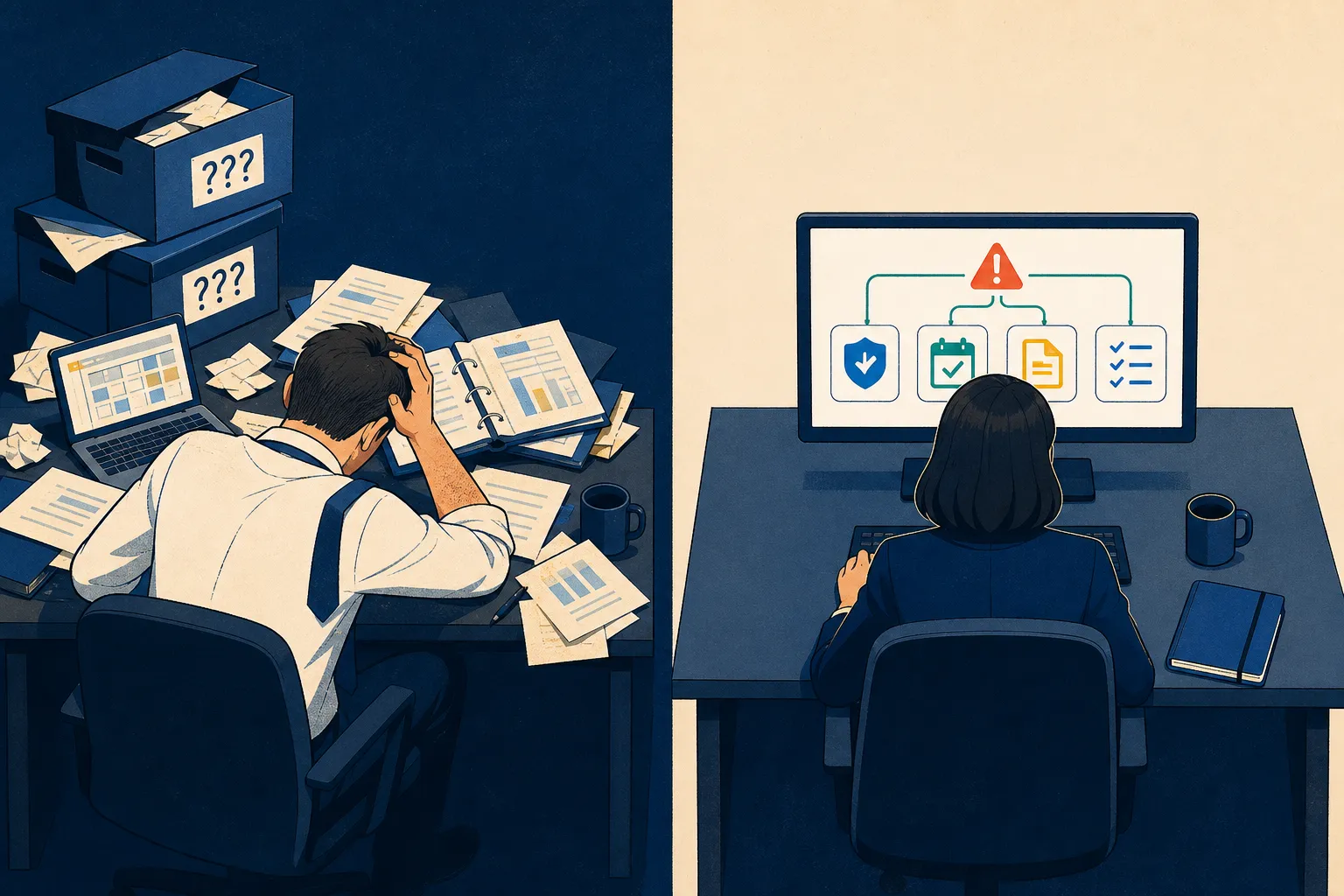
Here’s a slightly contrarian idea: having a proper GRC platform might be more important to the CEO than it is to the CISO.
I know, this can sound backwards. But hear me out.
The information security manager is the person using the platform every day. It helps them manage controls, risks, evidence, audits, policies, and compliance work. So naturally, GRC software tends to be seen as a tool for the security team — another line item in the information security budget.
For the CEO, it can almost look like a convenience.
It’s not a nice to have, or a convenience. One of the most important things a GRC platform gives a company is something much more fundamental: continuity.
Leadership changes reveal whether the security program truly belongs to the company
For many growing companies, the first dedicated information security hire happens because there is pressure to achieve something quickly. A large customer requires ISO 27001, a regulator introduces a new obligation, or an enterprise deal calls for SOC 2.
The company hires its first CISO, Head of Security, or Information Security Manager and gives them a fairly straightforward mandate: build the security program and get us where we need to be.
The hire works out. The program develops, the company reaches its objectives, and everybody is happy.
Or the hire doesn’t work out. The collaboration ends, and the company starts looking for someone else.
The second scenario is where the difference between having a GRC system and having a collection of GRC documents becomes painfully obvious.
A structured GRC system allows successors to continue the program instead of reconstructing it
Imagine the outgoing security manager has spent nine months building your information security program.
They have assessed risks, designed controls, mapped compliance requirements, created policies, collected evidence, coordinated audits, and worked with teams across the company.
If that work lives in a structured GRC platform, the next person walks into something understandable, neatly organised. They can see the requirements you’re working towards, the controls already in place, and the risks, assets, vendors, business processes, findings, tasks, and evidence connected to them — and how it all fits together. They can see what’s done, what’s overdue, and what still needs attention.
The new security leader still needs to learn the organisation, of course. But they are continuing an existing program rather than reconstructing one.
The CEO gets something valuable too: a reasonably clear view of where the company stands with it’s security posture and compliance. That’s institutional knowledge, and it belongs to the company.
Without a shared system, months of security work can become an archaeological dig
Without a GRC platform, the exact same nine months of work can leave behind a very different picture.
There’s a spreadsheet for the risk register and another for the control mapping. Policies live in Google Drive or SharePoint, evidence is scattered across folders, and there’s an audit tracker somewhere — plus a trail of Jira tickets, Slack messages, and notes explaining why certain decisions were made.
Some of the structure exists only because it made sense to the person who created it. And that person no longer works there.
The next CISO has to reverse-engineer the program. Which documents are current, and which controls actually operate? Which risks were accepted, and why? What evidence belongs to which requirement? Which recurring reviews are supposed to happen, and what was being prepared for the next audit?
Sometimes they can put the puzzle back together. Sometimes they can’t.
And when rebuilding the previous person’s system becomes harder than creating a new one, starting from scratch becomes a surprisingly rational decision.
Now you have lost months because the work was never captured in a system designed to outlive them.
Turnover makes security-program continuity a matter of when, not if
Even if your first CISO is fantastic, they probably won’t work for you forever. Neither will the second one. People change jobs, companies reorganise, responsibilities shift between teams, consultants finish engagements, and security leaders get promoted.
So the question isn’t whether someone will eventually need to inherit your security program. They will. The question is what you are going to hand them. A functioning system? Or an archaeological dig?
Continuity turns GRC from a security-team tool into company infrastructure
A good GRC platform should do more than make compliance administration easier. It should give the organisation a durable operating model for information security.
The company should be able to understand:
- what it is protecting;
- which risks matter;
- which controls exist and why;
- who owns the work;
- what needs to happen regularly;
- what has been completed;
- what evidence proves it; and
- where there are gaps.
That structure matters during audits, but it matters just as much between audits. It reduces dependency on any one person, makes onboarding easier, and makes management oversight possible. Most of all, it turns the information security program from somebody’s personal methodology into a company asset.
Treat the GRC program as a company asset, not an individual methodology
There will always be knowledge in people’s heads. Software cannot eliminate that, nor should it.
But the structure of your information security program shouldn’t disappear when someone leaves. Your risks, controls, responsibilities, recurring activities, evidence, and decisions should live in a system the organisation owns and the next person can understand.
That is how we think about GRC at Kordon. Not as a place to store compliance paperwork, but as the operating system for a security program: connecting requirements, risks, controls, tasks, and evidence so the program can keep running regardless of who happens to be managing it today.
Because eventually, someone new will have to pick up where the last person left off.
Make sure there is something for them to pick up.